

Dear arts writers and friends,
About a year ago, the Japanese American National Museum issued a statement warning of rising authoritarianism in the United States.
A year later, the museum gathered its community in Los Angeles and online to explore civic actions that go beyond the statement. The result was a prescient gathering, a serious, pragmatic exploration of what comes next.
I came away mindful of how artists and arts journalists model forms of meaningful citizenship.
It should not surprise us that a blog about tacos and everyday culture has become one of the more trusted sources on ICE actions in LA, and I encourage you to listen to the panel featuring Memo Torres of LA Taco and other close-to-the-ground Angelenos. Art critic and historian Tyler Green guided a conversation about defending culture in what he called a dangerous moment, ably shaping the conversation with essential context.
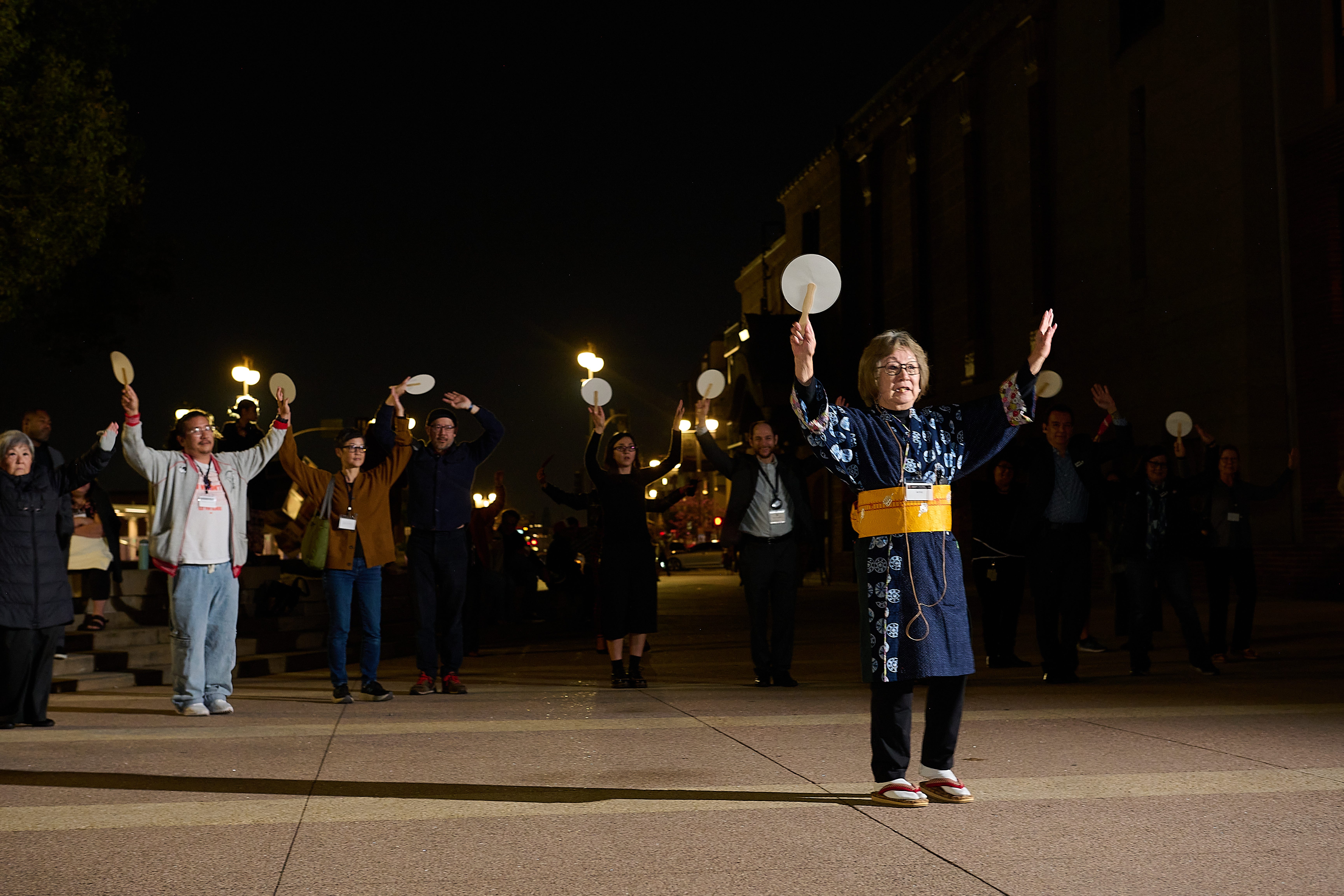
The gathering took place on a site where many Japanese American families in Los Angeles stored their belongings during World War II, when people had to leave much of what they owned behind during forced removals to concentration camps. That terrible history — and the knowledge that so few publicly criticized the U.S. government at the time — grounded the discussions. There was a weight to the day that nonetheless ended with joy, a participatory dance facilitated by Great Leap that left me jumping around my kitchen on a Friday night.
Much of the “Echoes of History” gathering can be watched online. I highly recommend it.
MEMORY AS A SOURCE OF POWER
The idea that memory is a source of power — and documentation a form of resistance — continues to surface from what many of you have been writing.
As the art world flows into California’s Southland for Frieze Los Angeles, Carolina Miranda (Rabkin Prize winner ’17) documents the many ways artists and institutions are showing up for immigrant communities with artful gestures of solidarity, often embedded right into the urban landscape, including neon signs, projections, workshops, mutual aid projects, downloadable protest signs, and intimate, pop-up performances in family-owned businesses.
In a piece for Art in America, Emily Watlington (Rabkin Prize winner ’24) and Alex Greenberger explore an earlier moment of solidarity, the Art Strike of 1970, occasioned by the expansion of the U.S. war in Vietnam into Cambodia, the shootings at Kent State and Jackson State and the eruption of violence in Augusta, Ga., after a Black teenager suspiciously died in a county jail. New York museums and galleries shuttered. The Guggenheim stripped the art from its walls. In the piece, eight artists reflect on that era of war and protest.
In writing about the artist-activist Ceija Stojka, who barely escaped World War II and lost much of her Romani family in the concentration camps, art critic Aruna D’Souza (Rabkin Prize winner ’21) explores work rooted in the past that is resonant today as well. Stojka turned to art in her late 50s, picking up paintbrushes at the kitchen table alongside her granddaughters, according to D’Souza’s review of the current Drawing Center show. Eventually, a desire to make visible the erasure of the Romani people surfaced in her expressive and at times minimal brushwork. “I’m afraid that Europe is forgetting its past and that Auschwitz is only sleeping,” Stojka once said.
Seph Rodney (Rabkin Prize winner ’20) makes a poignant and compelling call for imagined futures within certain types of solidarities in his review of the Bronx Museum of Art’s biennial. In seeking out works that peer beyond our current circumstances, Rodney made a close read of a sculpture by Jordan Corine Cruz, a gorgeous, drooping city bench made of red candle wax. It “won’t hold our weight,” Seph writes, intimating a need to stand “without inherited support.”
Insightful writing also continues to accumulate around the ambitious and uncannily right-on-time “Monuments” show at MOCA and The Brick, where Lost Cause monuments and their narratives are reforged. Miranda’s review for The New York Review of Books joins a piece by Siddhartha Mitter (Rabkin Prize winner ’24) on Kara Walker for The New York Times, Claudia Ross’ review for Hyperallergic, Julian Lucas’ piece for The New Yorker and Alex Kitnick’s for 4Columns, among others.
JETTISONING THE CRITICS, AGAIN
These essays and reviews represent the kind of world-apprehending writing and thinking that feel necessary right now and that come to mind when we see publications deprioritize arts journalism. One would have to miss a lot of what’s going on in the world to not see how much artistic activity is relevant to today’s headlines, from dance protests to sing-ins (like this and this and this and this). From the brass bands and drumming interventions to the zine organizing and protest quilts. From the ongoing rituals of artists (like this and this and this) to, for that matter Bad Bunny, and that Springsteen song. And let’s not forget the hundreds of Fall of Freedom events that have rooted across the country (and are returning on May 1).
The latest dismantling of cultural journalism happened at The Washington Post, as part of a larger decimation of that newsroom. Art critic Sebastian Smee (Rabkin Prize winner ’18) was among the hundreds of writers and editors jettisoned, along with much of the cultural section, including theater critic Naveen Kumar and film critic Jada Yuan. Philip Kennicott, art and architecture critic, remains on.
Of course important arts journalism is now happening beyond legacy publications. Recently, the Boston Art Review and Glasstire, art-focused regional art publications with a fraction of the resources and staff of legacy media, led coverage of two critical news stories. Kim Córdova reported on the abrupt layoffs of staff at the Museum of Fine Arts Boston (not to mention this exclusive) and Nicholas Frank has been covering the sudden shuttering of an exhibition that criticized ICE and the aftermath at the University of North Texas.
And speaking of changing media landscapes, a quick word of thanks to those of you who participated in a survey of independent publications, organized by Critical Minded and the Rabkin Foundation. The survey is closed, and we are pouring over the data. We look forward to sharing our findings soon.
THE BIG LIST
As always, here’s a digest of some of the arts writing we’ve been reading and are inspired to share.
Hilton Als on William Eggleston
Luiz Armando Bagolin on Lygia Pape
Jon Calame on ICE in Portland, Maine
Sarah Cascone on Elda Cerrato
Gabrielle Christiansen on the Roger Brown Study Center
Hadani Ditmars on Emily Carr
Jarrett Earnest’s amazing new podcast
Vanessa Friedman on Rama Duwaji
From Away to ME (a new program about our state!)
Robin Givhan on Jesse Jackson’s turtleneck
Eileen G’Sell on the film By Design
Lisa Hsiao Chen on Vaginal Davis
Adam Kirsch on the dying literary ecosystem
Alexandra Kleeman on Letterboxed
Lauren Moya Ford on Gail Levin’s Alice Baber book
Mateus Nunes on Lygia Pape
Maria Ressa on radical collaboration in media
Anya Sesay on a political art show
Hilarie M. Sheets on Edmonia Lewis
Rebecca Solnit on what tech takes from us
Hrag Vartanian on the Epstein files’ impact on the art world
Joe Ware on Epstein files artworld connections
Katie White on Graciela Iturbide
Sasha Wolf interviews Ocean Vuong
J Wortham on the ritual of repair
Kat Zagaria on identity and motherhood
Brandon Zech on Robert Rauschenberg
UPCOMING EVENTS
We are excited to be collaborating once again with our friends at SPACE and the Portland Museum of Art to bring you a screening of A Photographic Memory, an artful memoir-documentary by Rachel Elizabeth Seed. The filmmaker pieces together a portrait of her mother – the avant-garde journalist Sheila Turner-Seed – through use of a sprawling archive of lost interviews with icons like Henri Cartier Bresson and Gordon Parks. Please join us on March 19. You can RSVP for the pre-screening reception at our gallery and then get your tickets to the film at the PMA here.
If you think the idea of reading the news from a stage with musical accompaniment is pure brilliance, as we do, please give a little nod to the lovely humans at SPACE and get yourself a ticket because this one is tonight, Thursday, Feb. 26. Sophie Hamacher reads.
If you are an arts writer or critic looking for ways to gather with colleagues in 2026, Critical Minded has you covered. Check out their forecast of conferences and convenings.
Also, if you love print, Portland’s new magazine shop Bold is hosting a casual, after-hours industry gathering for editors, writers, designers, and publishers next Friday, March 6, from 6-8p. RSVP to hello@boldmags.com.
Finally, Danielle Yovino, our curator, and I will be in Baltimore next week for the Association of Writers & Writers Programs conference. We’re excited to meet up with a few Rabkin Prize winners, see the Amy Sherald show, and get a peek inside BmoreArt’s workspace and gallery. If you are going to be there, too, please let us know. We’d love to say hello.
As always, thank you for the work you do.
Warmly, and until next month,
Mary Louise
Thank you so much for the mention! I also wrote about democracy and dictatorship in Spain and Portugal recently for Hyperallergic: https://hyperallergic.com/the-disappearing-art-of-iberian-democracy/